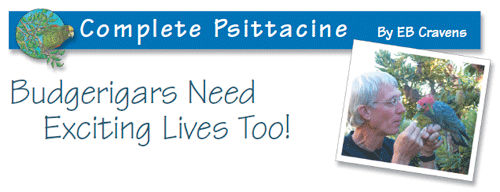
During my seven years managing a shoppe in the retail bird trade, I was continually struck by how little naturally stimulating enhancement was used in providing caging and habitat for tiny birds like canaries, finches, lovebirds and budgerigars.
Pet stores would house such species in miniscule 18 or 24inch cages, sometimes dozens at a time. Some novice owners would fret about spending an extra $20 or $30 in cage money for their new parakeet, then end up buying one of those little 12” prisons with plastic food and water cups hardly big enough for twenty four hours, let alone with space to forage or bathe in.
Read more in the magazine…
Buy a copy now!
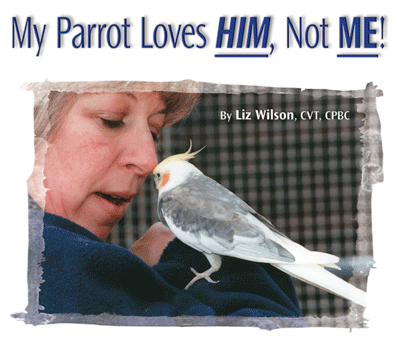
It’s easy enough for a new dog to learn who his ‘owner’ is. The owner is the person who feeds him. Obviously, the food giver is the most important human in his life! Not so with parrots. People, usually women, constantly tell me that they don’t understand why their parrot favours their husband, since the women are the ones that feed the bird and clean its cage.
“That makes you the maid,” I say. And it’s nothing personal, but being the maid does not earn the love of a parrot. Indeed, much as many of them love to eat, you cannot buy their affection with food. But properly used, treats can improve your image!
Read more in the magazine…
Buy a copy now!

In order to provide an effective holistic approach for healing feather destruction, a complete picture of the bird’s situation is needed. Using information provided to me from my client, Virginie, I evaluated every aspect of her bird’s living environment. We reviewed diet and nutrition, cage and habitat, household surroundings, lighting, air and water quality. After converting Chili Pepper, a female Quaker Parrot, to a diet based around feeding our 100 per cent Organic Original Sprouting Blend, with fresh fruit, vegetables, and specific nutraceuticals, we turned our focus to supporting Chili Pepper’s emotional healing.
Healing emotional trauma is a process. During a healing and communication session with an animal, I receive information in a variety of ways. I see pictures, I feel their emotions, and I can feel any physical pain they are experiencing. Through this mechanism, the parrot’s story, the source incident is revealed.
Read more in the magazine…Buy a copy now!
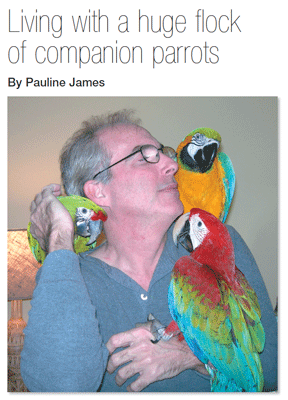
Dave and Tammy Kramer, and their son DJ, live and breathe parrots - it is their passion, their life and now their livelihood. In this first of two parts, Dave tells their story and introduces us to some very special members of his flock, including a very lovable rescue macaw, their super-intelligent African Grey, their quirky green Quaker, and a blissfully contented and adorable Umbrella cockatoo:
Our venture into the world of birds started many years ago, when I bought Tammy a baby cockatiel for St. Valentine’s Day. Tammy had prepared for the event by buying a suitable cage, and doing lots of reading. But, when we eventually went to the small pet store to select a bird, instead of coming out with a young cockatiel as planned, we were talked into buying an unweaned chick, by the unscrupulous trader.
We were totally unprepared for this eventuality, but were given a quick 10 minute ‘how to’ by the pet shop owner, and off we went with the tiny chick, a supply of hand-feeding formula and a syringe. What we hadn’t been told was how to wean the chick, and six months later we were still hand-feeding our baby!
But, Petie survived in spite of us! We were actually very lucky, because at that time we had no knowledge, or back-up about what to do if anything went wrong. But, we learnt a lot from our first cockatiel, and she is still a loyal friend to this day.
Read more in the magazine…Buy a copy now!
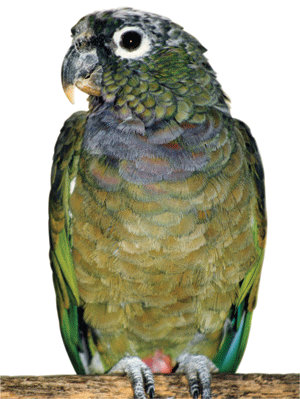
Enjoying Maximilian's to the max
The Maximilian’s Parrot (Pionus maximiliani), sometimes known as the Scaly-headed Parrot, due to the prominently-etched greyish-blue scalloping which adorns its green-bronze head-feathers, is a medium-sized, intelligent, easy-to-handle, but playful, quiet-natured parrot, and makes an ideal companion bird for bird-keepers with limited experience.
But, even though Maximilian’s are blessed with so many good qualities, including having a fair capability to mimic speech, and are not known for bouts of screeching, their popularity is on the wane. This is mainly because, greater numbers of their more colourful close relative, the Blue-headed Parrot (Pionus menstruus), are now being bred.
In addition to this, a variety of other pionus species, such as the Bronze-winged (Pionus chalcopterus), the Dusky (Pionus fuscus), and the White-crowned Parrot (Pionus senilis) are also just beginning to become more readily available. And, as a result, the more commonly-bred and once popular Maximilian’s, is now being forced to take more of a back seat, especially by those seeking a bright and colourful companion parrot.
Read more in the magazine…
Buy a copy now!
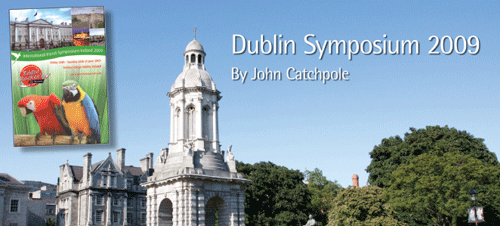
The British Isles has never been that well known for staging symposiums, conventions or even one-day conferences, but Jerry Kidd has changed all that. Over the weekend of 26th - 28th June, Dublin was the chosen city for staging the International Parrot Symposium, held in the world famous Trinity College. Speakers included some of the best known aviculturists, veterinarians, behaviourists and those who are regarded as authorities on bird management and welfare.
There are, of course, always issues that become controversial but trends are changing, and for the better. We are still at the very early stages of understanding all things to do with parrots and parakeets, but understanding is moving forward in a positive way that can only benefit our birds. This symposium covered the issues that are of great interest to all of us today.
Read more in the magazine…Buy a copy now!