
Supported By











Parrots Magazine
Whether you’re curious about parrot breeding, behaviour, conservation, or healthcare, we've got you covered. It’s like having a chat with a wise old parrot minus the squawking. We have lots of fascinating articles from leading aviculturalists and behaviour experts.
We produce a colourful, engaging and informative eMagazine delivered straight to your desktop every month.
Latest Edition
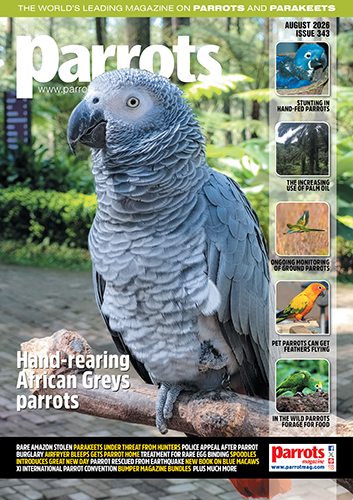
Sonny Stollenmaier has specialised in breeding African Greys and describes hand-rearing them as ‘a pure joy’. He shares his advice and tips for successful hand-rearing of these popular companion parrots.
They are unique and they are blue, and are Brazil’s Hyacinth’s, Lear’s and Spix’s Macaws, but sadly, the Glaucous Macaw, has been extinct for about 100 years. One by one they were hit by catastrophic happenings and their stories need to be told.
Refined palm oil is the most widely produced and consumed vegetable oil world-wide. It is extracted from the fruits of the oil palm (Elaeis guineensis), with a very small niche market accounting for red palm oil.
The accepted practice of hand-feeding parrot chicks in order to make them into social house pets has a sobering downside to it. There are quite a few undersized pet psittacines coming on the market, so buyers need to beware!
Passive Acoustic Monitoring is a non-invasive technique that uses autonomous recording for the ongoing monitoring of Ground Parrots in Australia. These compact devices installed in natural habitats listen to sounds in the environment.
Searching for food in nature is a constant task in the world for birds. In the early morning, they preen, activate their flight, absorb solar energy, and move in search of sustenance. Some have to fly long distances, as not all live near water and food.