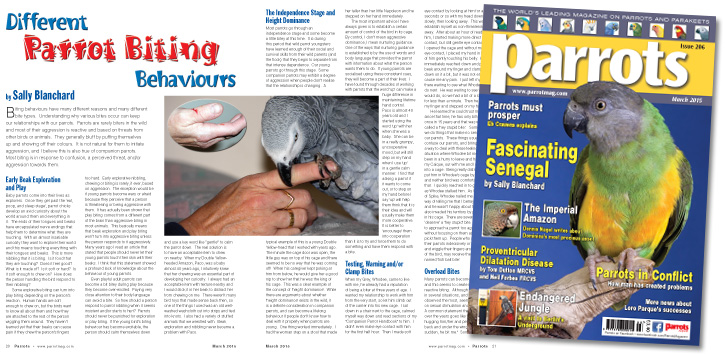
By Sally Blanchard
Biting behaviours have many different reasons and many different bite types. Understanding why various bites occur can keep our relationships with our parrots. Parrots are rarely biters in the wild and most of their aggression is reactive and based on threats from other birds or animals. They generally bluff by puffing themselves up and showing off their colours. It is not natural for them to initiate aggression, and I believe this is also true of companion parrots. Most biting is in response to confusion, a perceived threat, and/or aggression towards them.
Baby parrots come into their lives as explorers. Once they get past the 'eat, poop, and sleep stage', parrot chicks develop an avid curiosity about the world around them and everything in it. The ends of their tongues and beaks have encapsulated nerve endings that help them to determine what they are touching. With an almost insatiable curiosity they want to explore their world and this means touching everything with their tongues and beaks. This is more nibbling that it is biting. Is it food that they are touching? Does it feel good? What is it made of? Is it soft or hard? Is it soft enough to chew on? How does the person handling the bird respond to their nibbling?
Buy Now!
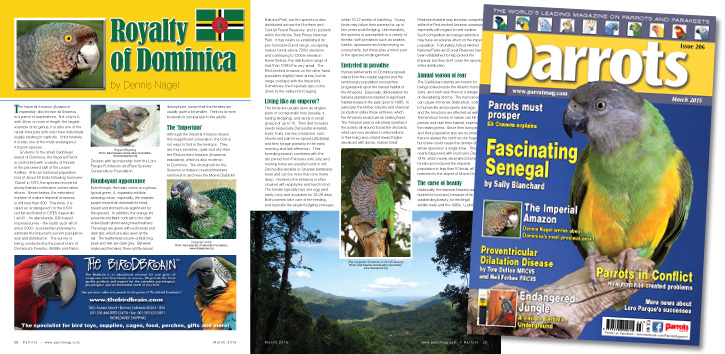
By Dennis Nagel
The Imperial Amazon (Amazona imperialis), also known as Sisserou, is a parrot of superlatives. Not only is it, with 45cm or more in length, the largest example of its genus, it is also one of the rarest Amazons with only three individuals legally existing in captivity. Unfortunately, it is also one of the most endangered Amazon species.
Endemic to the small Caribbean island of Dominica, the Imperial Parrot is confronted with a variety of threats in the perceived idyll of the Lesser Antilles. After an historical population loss of about 50 birds following hurricane ‘David’ in 1979, the species recovered slowly thanks to intensive conservation efforts. Nevertheless, the estimated number of mature Imperial Amazons is still less than 400. Therefore, it is rated as ‘endangered’ on the IUCN red list and listed in CITES Appendix I and II. An island-wide, GIS-based Imperial survey - the fourth such effort since 2000 - is presently underway to estimate the Imperial’s current population size and distribution. The survey is being conducted by the parrot team of Dominica’s Forestry, Wildlife and Parks Division with sponsorship from the Loro Parque Fundación and Rare Species Conservatory Foundation.
Buy Now!
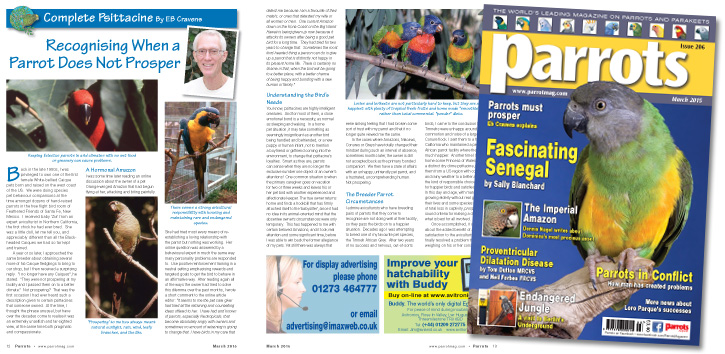
Recognising When a Parrot Does Not Prosper
By Eb Cravens
Back in the late 1980s, I was privileged to own one of the first female White-bellied Caique pets born and raised on the west coast of the US. We were doing species pet behaviour comparisons at the time amongst dozens of hand-raised parrots in the free flight bird room of Feathered Friends of Santa Fe, New Mexico. I received baby ‘Zia’ from an expert aviculturist in Northern California, the first chick he had ever bred. She was a little doll, let me tell you, and appreciably different than all the Black-headed Caiques we had so far kept and trained.
A year or so later, I approached the same breeder about obtaining several more of his Caique fledglings to bring to our shop, but I then received a surprising reply. “I no longer have any Caiques”, he stated. “They were not prospering at my facility and I passed them on to a better climate.” Not prospering? That was the first occasion I had ever heard such a description given to certain psittacines that someone owned. At the time, I thought the phrase unusual, but have over the decades come to realise it was an extremely unselfish and far-sighted view, at the same time both pragmatic and compassionate.
Buy Now!
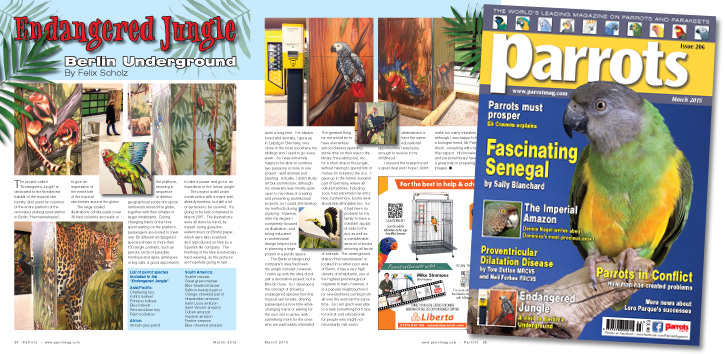
By Felix Scholz
The project called "Endangered Jungle" is dedicated to the threatened habitat of the tropical rain forests, and uses the columns of the entire platform of the renovated underground station in Berlin, "Hermannstrasse", to give an impression of the entire belt of the tropical rain forests around the globe.
The large-scaled illustrations continuously cover 36 tiled columns and walls of the platform, showing a sequence of distinct geographical zones of tropical rainforests around the globe, together with their smaller or larger inhabitants. During changing trains or the time spent waiting on the platform, passengers are invited to meet over 80 different endangered species shown in more than 150 single portraits, such as parrots, birds of paradise, monkeys and apes, antelopes or big cats, a good opportunity to take a pause and go for an expedition in the ‘urban jungle’.
Buy Now!